
Your suppliers and service providers are using AI — Is your invoice reflecting it?
Artificial Intelligence is changing what it costs some of your suppliers and service providers to deliver their products and services, and few buyers in transport, logistics and maritime are raising it at the table. This guidance note sets out where those savings are likely to sit, what recent research shows and does not show, and how to open the conversation with your suppliers and service providers credibly.
Your service provider base is more digital than your fleet
Transport, logistics and maritime businesses invest heavily in assets, fuel, port services, and the people who keep cargo moving. Yet an increasing proportion of expenditure is directed towards service providers whose work is primarily knowledge-based and delivered through digital platforms. This includes software and IT services, documentation and customs brokerage, freight auditing, legal services, outsourced customer support, ship management administration, and back-office finance functions.
It is within these service-intensive areas that AI is gaining traction first, potentially reducing the cost of service delivery in ways that may not yet be reflected in pricing. This article explores why transport, logistics and maritime businesses should begin a constructive dialogue with their service providers about the impact of AI on efficiency, productivity, and cost.
The central point is a simple one: while AI is already automating meaningful aspects of many professional and administrative services, its impact remains uneven and, in many operational and asset-based activities, relatively limited. As a result, informed, evidence-based discussions about value and pricing are likely to be productive; blanket demands for fee reductions are not.
What the evidence says about where AI is actually being used
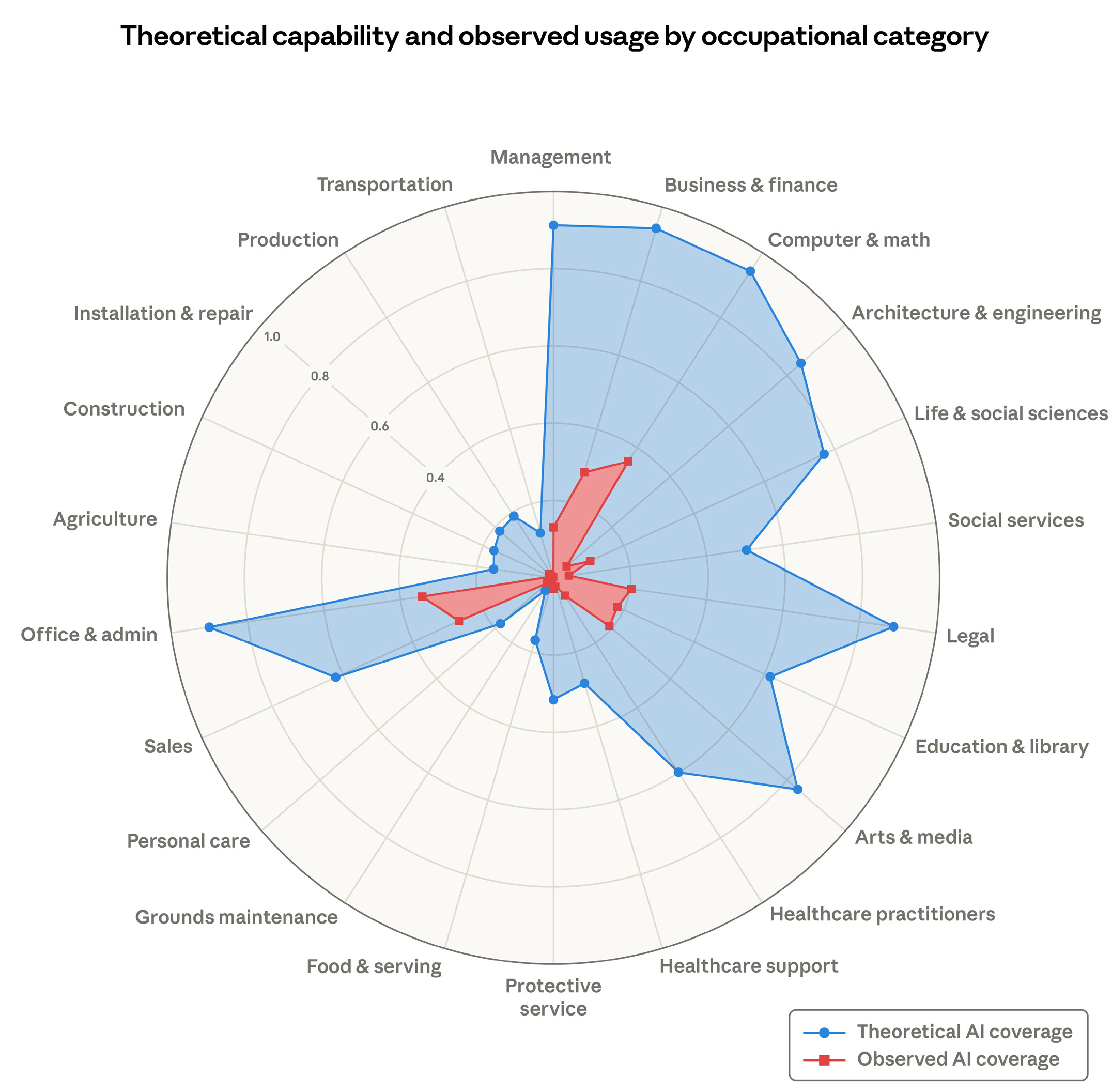
Much of the public debate about AI swings between hype and dismissal. A useful corrective comes from Anthropic's economists, who built a measure called observed exposure. Rather than just asking what AI could theoretically do, it also asks which tasks are actually being automated in work settings today. It combines three things: whether a task is theoretically feasible for automation, whether it shows significant real-world work usage, and whether that usage is automated rather than merely assisting a human, with automation weighted more heavily.
Two findings matter for buyers:
- Real usage is concentrated in a few kinds of workThe most exposed occupations in the study are computer programmers (75% of tasks covered), customer service representatives, and data entry staff (67%). Financial analysts and legal services also rank among the most exposed. If your service providers sell software development, customer support or legal services, a meaningful share of their delivery work is probably already being done with AI.
- Actual use is far below what is technically possibleThe report finds AI is far from reaching its theoretical capability. In IT occupations and in office and administrative occupations, for example, AI could in theory speed up around 94% and 90% of tasks respectively. Yet observed coverage in IT is just 33% - so far.
For transport, logistics and maritime buyers, the implication is a split service provider base. The hands-on suppliers that move, lift, repair and crew your assets are likely to sit near the zero-coverage end. The digital, legal service and administrative layer around them sits much closer to the exposed end. Savings will be real but uneven, and likely to grow as capabilities improve and adoption spreads.
Source: Anthropic Report on Labour Market Impacts of AI: A New Measure and Early Evidence — March 2026
Where to look in your service provider base
The exposure data offers a practical way to prioritise engagement with service providers. Those whose services are built around tasks identified by the research as highly exposed to AI are more likely to be capturing productivity and cost benefits. The list below ranks typical transport, logistics and maritime service providers according to their likely level of AI exposure and potential efficiency gains.
- Software, IT and data — High exposureTechnology providers supporting fleet and voyage management, electronic data interchange and digital integration platforms, as well as offshore development and administrative support teams operating across the transport, logistics and maritime sectors. Programmers are the most exposed occupation in the report.
- Customer service — High exposureOutsourced booking, tracking, shipment-status support, and help desks. Customer service representatives rank second in the report.
- Documentation and data processing — High exposureCustoms brokers, bill of lading and manifest processing, invoice capture, freight audit and payment. Roles involving data entry and routine information processing are particularly exposed to AI-driven automation.
- Finance and analysis — High to mixed exposureOutsourced accounting, demurrage and detention analysis, cost reporting. Financial analysts are among the most exposed occupations.
- Legal services — Mixed exposureTasks traditionally assigned to junior lawyers and paralegals, such as contract and charterparty review, trade compliance and regulatory advice, and aspects of dispute management and resolution. High exposure for legal research, drafting and document review; low exposure for advocacy and client representation in courts.
- Ship and fleet management administration — Mixed exposureTechnical and commercial management, crewing and payroll administration, planned-maintenance paperwork, compliance reporting and survey. The administrative layer is more exposed than shipboard work.
- Physical operations — Low exposureHauliers, stevedores, tugs and pilotage, repair yards and drydocks, warehouse labour, bunker supply. Hands-on tasks barely appear in the usage data.
It is important to note that the report classifies occupations, not transport, logistics or maritime sub-sectors. The categories set out above reflect our assessment of how the relevant occupations and associated tasks map onto activities commonly performed across these industries.
Four practical steps to capture AI-driven savings
- Map your spend against AI-exposed activitiesBreak contracts down by the tasks being delivered, not just the service provider. Start with the software, IT, legal services, administrative and data layer: per-document, per-transaction and per-hour charges for work AI can now do, such as customs entries, bill of lading processing, freight audit, tracking queries and other routine administrative tasks.
- Ask before you assertOpen with questions: where is AI being used in the delivery of your services? How has AI affected the level of effort, staffing requirements, or cost per unit of output? What further AI deployment or process changes are planned over the next 12 to 24 months? The answers will provide valuable insight into whether efficiency gains are being realised and whether those benefits are being shared with customers or retained by the service provider.
- Build in review mechanismsRather than seeking a one-off price reduction, consider incorporating benchmarking provisions or periodic price review mechanisms into contracts, aligned with annual tender processes and renewal cycles. This enables efficiency gains arising from advances in AI capability and adoption to be assessed and reflected over time.
- Share the benefits, without compromising standardsService providers are investing heavily in AI capabilities and assuming the associated risks. A balanced gain-sharing approach can incentivise continued innovation and investment, while ensuring that quality, safety, security and compliance remain uncompromising priorities. In regulated or safety-critical activities, buyers should seek clarity on how AI-generated outputs are reviewed, validated and approved by qualified personnel, and where ultimate accountability lies if an error occurs.
AI's impact on the wider economy remains at an early stage and can be difficult to quantify. However, across the digital and administrative functions that underpin the transport, logistics and maritime supply chain, the effects are already tangible. Buyers that understand where AI-driven efficiencies are being created, engage suppliers and service providers with informed questions, and structure commercial arrangements to share in those gains over time will be better positioned than those that either wait for savings to become self-evident or seek cost reductions without a clear evidential basis.
If you would like support in identifying where AI-enabled efficiencies may be emerging within your supply chain, or in preparing for constructive discussions with suppliers about how those benefits should be measured and shared, please get in touch.